
From edtech to less tech
For years, teachers who used the most technology were considered the most innovative. Things may be changing.
🌸 Happy April, dear readers.
Less than two months till summer break – but who’s counting?


Before we dive in, you may remember that last month we said there’d be some changes to our newsletter structure. However, we’ve decided to stick with our current model. We hope you’ve been enjoying TTWS!

Testing season is upon us
The final months of the school year can be some of the most demanding: test prep, final projects and papers, events and ceremonies…oh my!
This is a simple reminder to prioritize self-care wherever possible in your busy schedule. Here’s a printable tip-sheet on preserving your energy and keeping your cup full up until June.
Activity idea: Comment Section

When social media users scroll through short-form videos, they often jump straight to the comment section before the video can even finish playing. This is a concerning habit for developing teens because it normalizes surface-level (or even half-baked) opinions.
Encourage your students to engage in deeper conversation by inviting them to act as a real-life “comment section.” Here’s how you can facilitate:
Show a piece of short-form media that you find to be generative or thought-provoking. Find two video examples below.
Depending on how you prefer to engage your class, have students respond with their “comments” by doing a rapid-fire turn-and-talk or whole-class discussion. Students’ takes will most likely be a mix of goofy and conversational.
Next, give students 2-3 silent minutes to individually write their comment in notebooks or on post-its. They will likely be left with extra time to reflect on what they wrote, and edit it to be more thoughtful.
After the activity, ask your students to compare and contrast both versions of processing the content. Students may point out differences in depth, comprehension, and overall quality of commenter’s contributions.
Feel free to source your own video examples, but here are two that are sure to get your students talking about their digital wellbeing:
This video shows a young man on a hike in a picturesque nature landscape. Yet he admits to doomscrolling in the midst of it. Students may share similar experiences about dopamine, constant stimulation, social media addition, or not being able to feel present.
This video shows another young man running a race and high five-ing people in the crowd. It cuts to the “heart” reactions you receive (or don’t receive) when you post on social media. This highlights one of many unspoken rules around how we interact online. This can prompt students to share their own experiences around unspoken rules around posting and external validation.
Creator highlight: Dr. Aaron Carroll (Healthcare Triage on YouTube)
People are increasingly turning to faulty AI chatbots for their medical concerns in the wake of complicated insurance policies, hard-to-see doctors, and sheer embarrassment. Healthcare Triage is a YouTube channel that factchecks health advice and regularly demystifies academic studies and the latest health trends. HT’s host Aaron Carroll recently broke down a study about whether brain training games are effective for preventing dementia and some misleading takeaways."

#HTS’s curriculum in action


We observed local New York City students using our digital wellbeing curriculum Social Media U. We developed a game called Mad Grab, which is featured in our seventh grade lesson “Dopamine Dip.” The lesson introduces how technology affects our dopamine levels and provides real ways to avoid the intense mood spikes and crashes that follow.
🧠 Want to introduce dopamine to your students? Our curriculum Social Media U has science-backed lessons on how tech affects teens’ brains and bodies. Get in touch with us!
Edtech overuse
This week, many teachers were quoted in EdWeek emphasizing how edtech products’ bells and whistles have been said to add more disruption rather than streamline learning. Simply introducing devices into a lesson can sidetrack instruction:
“Recently, I have found students request paper assignments. Most students who request online assignments are those who are consistently absent. In my class, students use their computers to play games during my lectures or message other students. They are constantly distracted.”
—High school teacher—English/language arts/literacy/reading | Maryland
(EdWeek, April 2026)
The Hechinger Report’s Senior Early Childhood Reporter Jackie Mader recently covered how more schools are choosing to swap tech out in their classrooms due to growing concerns around the effects of excessive screen use. She went into a school in Ossining, NY to see how one teacher is using less tech in her classroom. Watch the one-minute video over on LinkedIn.
A Kansas middle school was covered in The New York Times for having all students turn in their Chromebooks mid-way through the year. The principal remarked that “technology can be a tool. It is not the answer to education.”
📵 Want to curb tech use in your classroom but not sure how? Our digital wellbeing curriculum Social Media U’s lessons require no tech for students. We’d love to chat with you!
[Due May 20th] Help us nominate teen leaders!
We rely on nominations from teachers like you to make sure we are reaching the right youth:
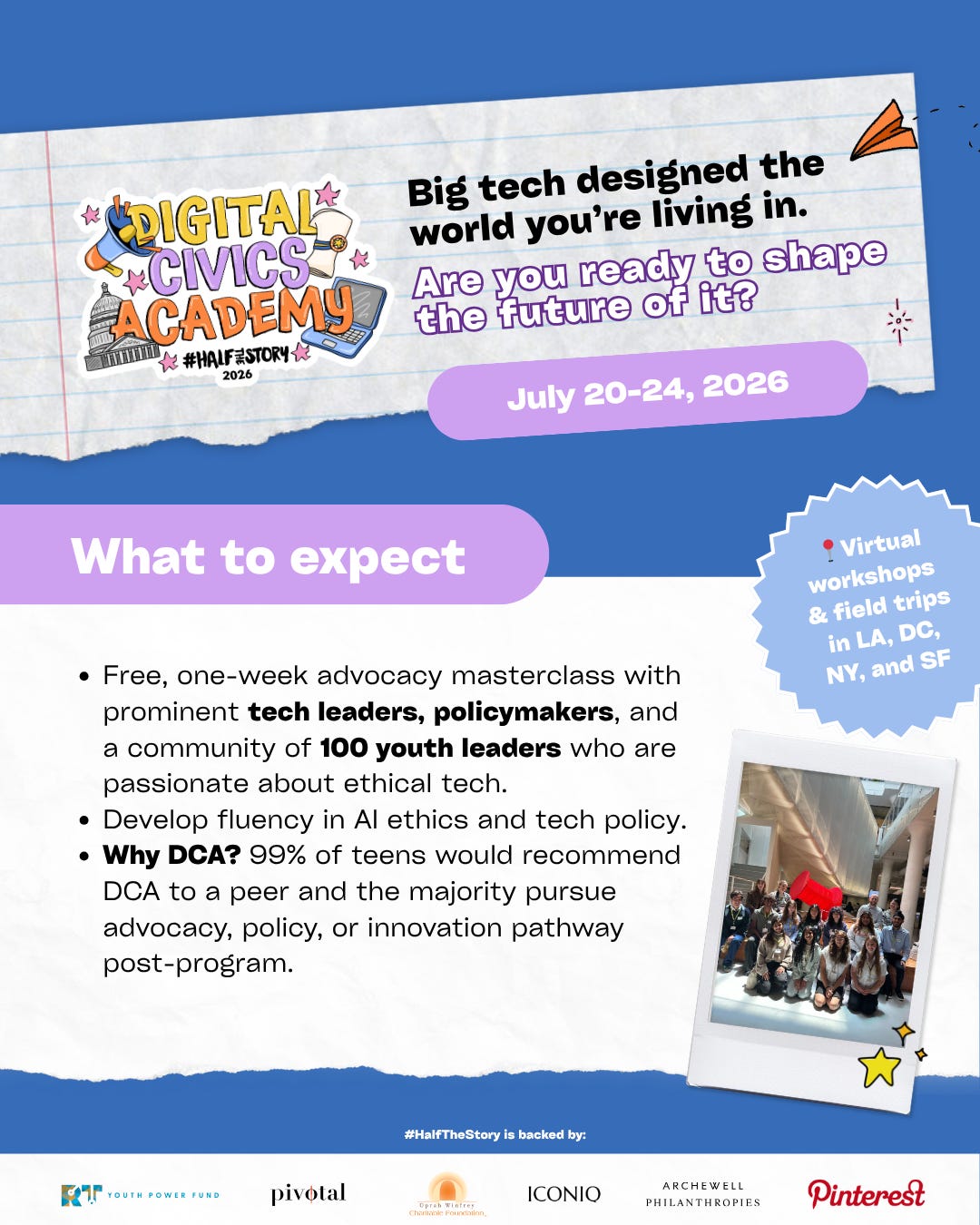
☀️ Do you know any teens looking for an exciting leadership opportunity this summer?
Over the past two years, the Digital Civics Academy, a free, one-week advocacy masterclass, has equipped 110+ teens across 60+ cities and 6+ countries with the tools to lead in digital wellness and responsible tech.
Our programming has featured distinguished speakers such as New York State Senator Andrew Gounardes, and Azza Cohen, official videographer of Kamala Harris. As part of this week, we’ve brought students to the table at the Pinterest and Snapchat offices, and into direct conversation with legislators at the California State Capitol. We are building a national pipeline of youth advocates shaping policy, storytelling, and digital wellbeing in their communities.
Confirmed speakers for this year include: Alyson Stoner (multi-disciplinary entertainer, NYT bestselling author), Laura Marquez-Garrett (attorney at Social Media Victims Law Center), Lee V. Gaines (education reporter for NPR), and Dylan Keith Humphrey (youth advocate, storyteller, and impact leader).
Learn more in our 2-pager and Digital Civics Academy 2025 Recap Video.
👉 We invite you to nominate up to three exceptional young leaders (ages 15-21) from your community to apply. Nominated students receive exclusive early access and priority consideration. Please submit your nominations by May 20th:
No additional work is required! #HalfTheStory will reach out directly to nominated students in the coming week(s).
In other Teen Digital Wellness news:
The Lancet Child + Adolescent Health: One of our #HalfTheStory Teen Advisory Board members was featured in this breakdown of Meta’s recent lawsuit. (April 2026)
The Pew Research Center: New data on how teens are using SnapChat, Instagram, and TikTok (April 2026).
ScienceNewsExplores: This article features commentary from a #HalfTheStory teen on ways to asses media use and take care of mental health. (March 2026)
The Rithm Project: This report covers the latest research on youth, AI, and relationships. (March 2026)
Wired: High school teens are using AI-generated memes to make ‘Slander Pages’ on social media about their teachers and principals. (March 2026)

Credit: David Quiroz on TikTok
#HalftheStory is a 501(c)(3) non-profit on a mission to empower the next generation’s relationship with technology. We believe digital wellbeing is a fundamental human right.
